Monday, February 25, 2008

2008 Resurgence Conference Live

If you'd like to watch, or just listen in the background, to some good preaching over the next couple days, make sure you check out the 2008 Resurgence Conference here.

You can choose the speakers you want to listen to (Mark Driscoll, C.J. Mahaney, Matt Chandler, Jim Gillmore, John Piper) and then make sure you're online when they start.

I hope you enjoy. I have it on in the background while I do research so I just listened to the end Mark Driscoll's first message (and it was really good) and now I'm excitedly anticipating C.J.'s in 5 minutes!

Labels: ,

Tuesday, November 20, 2007

Preached @ TMC!!!

Hi Everyone!!!

I just wanted to let you know that God REALLY used your prayers today at The Master's College. When I got there the guy who plans the chapels, Pete, said "When John MacArthur found out a TMS grad was speaking he decided to be here," to which I literally screamed "What!?!" as my stomach dropped. He was just kidding though (ha ha, reeeeeeally funny!)--thank God (you notice yet that I struggle with the fear of man?).

Just so you know, I scrapped Psalm 100 (I just couldn't make it work no matter how hard I tried) and instead spoke from John 13:34-35 on the absolute, unquestionable necessity of Christians to love every Christian...period! I tried really hard (which means I got little sleep last night) to be accurate with what I was saying about the text, as well as clear, passionate, persuasive and practical.

Well, in God's kindness I got some good feedback from a small handful of students, my friend Austin who made this all possible got some good feedback and Pete told me he and the school really needed that message and he told me he'd love for me to come preach again next semester.

He and I got to talking more about some of his church experiences and some of my experiences at TMS, and then out of the blue he asked if I'd speak at the Truth & Life Conference in January--a yearly conference for college students that he told me attracts between 1 and 2000 (this year's line up is John MacArthur, David Wells and James MacDonald). So, it looks like I'll be doing a workshop there next year!

All the while, Pete's asking me to speak at Truth & Life and explaining the conference and I'm thinking "What in the world is happening right now?" I don't know what God's up to and I do not consider myself worthy in the least to be doing any preaching from God's Word, let alone at this conference or any conference, but I want to make sure all of you know how grateful I am for you, your prayers and your support.

In a very real sense, you were a blessing to the students and faculty of TMC this morning too because of your prayers for them and me.

Labels: ,

Friday, November 16, 2007

Messages on the Trinity

Just in case you were wondering how my recent 2-week series at The Refuge on the Trinity went, I wanted you to know that it did not turn people off or away.

Rather than hurting the ministry, which is conventional "wisdom" for pastoral ministry today when it comes to teaching doctrine to Christians--let alone those in college & their 20s--just the opposite has happened.

Actually the ministry grew, newcomers came back for more and the Christians have a renewed zeal to study the Bible and reach out to, rather than run away from, cultists (Oneness, JWs, Mormons) and false religions (Jews, Muslims) who explicitly deny the Trinity.

Thank God for His marvelous grace for blessing His Word when we talked about Him--Father, Son and Holy Spirit!!!

Labels: , , ,

Thursday, September 27, 2007

What's in it for God?

I came across this quote from Dr. Michael Horton's book Made in America, and had to share it here:
"The older theology tended to produce character. By the end of the twentieth century, we have become God's demanding little brats. In church, we must be entertained. Our emotions must be charged. We must be offered amusing programs. We give up a lot to become Christians and what little teaching we do get must cater to our pragmatic, self-centered interests. Preaching must be filled with clever anecdotes and colorful illustrations with nothing more than passing references to doctrine. I want to know what this means for me in my daily experience. Have we forgotten that God is a monarch? He is the king, by whom and for whom all things were made and by whose sovereign power they are sustained. We exist for his pleasure, not he for ours. We are on this earth to entertain him, please him, adore him, bring him satisfaction, excitement and joy. Any gospel that seeks to answer the question, "What's in this for me?" has it all backwards. The question is, "What's in it for God?"
I have nothing to say in response except I think he's dead right.

Labels: , ,

Monday, September 10, 2007

9Marks Interviews David Wells

I've had this 9Marks interview of David Wells, one of my favorite living authors, on my desktop to read for weeks now, and I'm so glad I waited until now to do so.

I've interviewed many college and young adults' pastors about their ministries with my new job. Time after time all I hear about from them is that I need to make a group where people will connect with each other. Connecting, making friends, fellowship is the most important thing to someone in their 20s or 30s, they say, so this is the main goal of your ministry and the main thing that should fill up your time.

David Wells, thankfully, says
"we have replaced the pulpit not even by a barstool, but by a cup of Starbucks coffee, which speaks of 'human connecting.' And human connecting has become more important to us than our hearing from God."
I felt strange and out of place as I talked with these man because I always saw preaching as the most important aspect of my job (loving people = connecting with them is second), but so many disagreed.

Dr. Wells also says this, which turns conventional ministry "wisdom" upside down too:
"...the results of some important research among formerly unchurched people who then came to church are shocking. When these individuals were asked what they liked about the church, ninety-odd percent said that what was preached was important to them. And almost 90 percent said that they wanted to know what the church believed. They wanted to hear its doctrine. Now that is just the reverse of what the common outreach approach assumes. It assumes people don’t want to know. In actual fact, those who want to come into the church do want to know."
Finally, I loved this line from the interviewer:
"for the local church preacher, 'Show sensitivity to the alienation, the inner angst, the emotional turmoil people feel; yet use all these to segue to the Word of God and the more fundamental measurement of their relationship to him.'"

Labels: , , ,

Saturday, September 08, 2007

Premoderns, Moderns & Evangelism

David Wells, in his excellent book Above All Earthly Pow'rs, writes insightfully about the difference between premodern and modern societies and their relationship to God:
"In premodern societies, the sacred was a matter-of-fact part of life; in modern societies, God has been excluded from public life, pushed to the margins of relevance, and made to live out his life, as it were, underground and out of sight" (27).
Why mention this seemingly academic difference? Because when you're witnessing or speaking to a poorly discipled Christian, and they don't understand your Christian commitment, it may be because you're coming across as a premodern to a modern or postmodern person.

For example, if you see the hand of God in every event of your life and you see living a life that is pleasing to Him as most important than you're thinking and acting and interpreting the world as a premodern (which I'd add is closer to the biblical view of life).

However, if God is a kind of after thought in your life, and your personal history as well as world history is interpreted without any thought of God that's more modern and postmodern--and far less biblical, I might add.

Often times, our miscommunication comes from the fact that we're approaching all of life from different eras. We need to know this if we're going to communicate the premodern gospel to modern and postmodern people effectively.

Labels: , , , , , ,

Saturday, June 23, 2007

Exposition Gone Wild

This is an excellent article about sermons that pastors think are expositional, but really aren't.

An expositional sermon is one where the point of the biblical passage is the point of the sermon.

With that as the definition, read this article and see how exposition can go wrong.

Labels: ,

Thursday, April 26, 2007

Are You Being Squeezed???

Have you ever noticed that invisible forces, influences we swim in constantly but rarely ever notice, are constantly shaping how we understand life, God, others, ourselves, what's important, what's not, etc.?

And, have you ever noticed how what we think about the world, what we think it's all about, impacts how we experience that world. Don't know what I mean? Let this illustration from David Wells' Above All Earthly Pow'rs help:
"...a materialistic scientist and an animist who believes that trees have souls comparable to hos own will look at the same trees rather differently. The difference lies not in the trees, but in the interpretive framework in which they are understood" (20).
In the margin of my book I wrote that the difference also lies in who has the correct understanding of the tree, the understanding of the tree that matches what the tree actually is.

Why does all this matter? When a belief matches reality, we use a specific word to describe that particular kind of relationship between belief and reality. That word is "truth."

When we are "conformed to this world" (Rom 12:2), when we let the world system squeeze us into it's mold so that we think and feel and desire and live like that world, we are living in direct opposition to the truth.

This is why it is so important for Christians to attend churches that don't just make them feel good. Feelings don't sanctify. Feeling are a thermometer for our sanctification. Truth sanctifies (John 17:17), and we need churches that take us deeply into God's truth.

I had lunch with a friend of mine this week and we were talking about preaching. I remember reading an article by John MacArthur, I think it's the first article in the first TMS Journal, about the relationship between inerrancy and preaching.

The gist of his argument was that you see what people really believe about the Bible in their preaching. If you believe the inspiration of the Bible is verbal, reaching down to the very words on the page, than you will preach every word on the page. You'll feel like you're sinning if you don't explain every nook and cranny because you're skipping something God wanted said. You don't do that, you must revisit what you think about the Bible because your actions contradict your doctrinal statement.

We need pastors and churches that preach and live according to what their doctrinal statements say about the Bible. We have that, and Christians will have a much harder time "fitting in" with and feeling comfortable around and being energized by the things of this world. Instead, they'll feel at home in the truth because they're being "transformed by the renewing of their minds" (Ron 12:2).

Labels: , , , , ,

Thursday, April 19, 2007

Towards an Exegetical Theology by Walter Kaiser

Dr. Kaiser’s goal in Toward an Exegetical Theology is to fill in a gaping hole in the academic preparation for ministry “between the study of the biblical text...and the actual delivery of messages to God's people,” by teaching the student “how one moves from analyzing the text over to constructing a sermon that accurately reflects that same analysis and is directly dependent on it” (8).

He seeks to accomplish this though what he calls the syntactical-theological method, which does not replace, but instead adds to the grammatico-historical method, seeing the twin ideas of syntactical (ch. 4, 8) and theological studies (ch. 6) as the bridge across the gap.

After introducing the book by summarizing modern catastrophes in exegetical studies, he shows what exegesis is and is not by surveying the history of exegesis (ch. 1-2).

He defines exegesis as the diligent “practice of and the set of procedures for discovering the author’s intended meaning” (47), with the homiletical goal of proclaiming God's Word “in such a way that it can be heard with all its poignancy and relevancy to the modern situation without dismissing one iota of its original normativeness” (48).

The major section of the book is devoted to explaining his method of interpretation (ch. 3-8), after which he applies the method to three specific biblical genres (ch. 9-11).

He is keenly aware that his very detailed book may have just made the process of going from exegesis to exposition overwhelming, so he concludes with a big picture reminder to preachers of the need for the Spirit’s ministry and power though His Word in their lives and ministries.

Sadly, I have owned this excellent book for well over five years, but only read it when I was assigned to do so in seminary. I say "sadly" because this book is immensely helpful and formative for what is becoming the exegetical method I will follow as I embark on the journey of preparing sermons for the rest of my life (Lord willing).

Labels: , ,

Sunday, March 25, 2007

Preaching the Cross

For those of us who could not make it to the epic Together for the Gospel conference last April, Crossway is making the seminars available in written form in this upcoming book, Preaching the Cross.

This new book includes such topics as watching your life and doctrine (Mahaney), why expositional preaching is particularly glorifying to God (Piper), the pastor's understanding of his own role (Dever) and the center of Christian preaching: justification by faith (Sproul).

Crossway has definitely set itself up as one of the best alternatives to the undiscerning publishers like Baker, IVP, Eerdmans and Zondervan.

Labels: ,

Friday, March 23, 2007

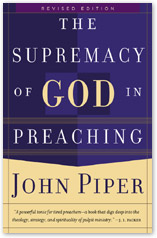
The Supremacy of God in Preaching by John Piper

John Piper’s goal for The Supremacy of God in Preaching is “to advance a movement of God-centered worship and life” by encouraging pastors to “show the truth of Christ and savor the glory of Christ” in their preaching.

In order to achieve the “exposition of the Word of God and exultation in the God of the Word” (11), the entire book reminds pastors of preaching’s goals by way of the Trinity’s role in preaching and Jonathan Edward’s expositional philosophy.

Piper argues for preaching as uniquely designed by God with the dual goals of informing the mind (seeing God) and igniting the emotions (savoring God). He wants to make sure pastors do not sacrifice one for the other, but see to it that our preaching reaches both aspects of the human soul (15, 23, 84-88).

The preaching he has in mind gives people an enlarged vision of their great God (15, 41) which restores the His throne in their souls (25, 27). However, this will not happen unless the preacher's words come from a heart that is enraptured by God (15, 25) and the gravity of His message (103-5).

On a personal note, I found myself constantly writing “Me?” in the margins. These markings are to be checks on my life the next time I pick the book up. When I read it again I will ask, “Does this describe you or not?”

Some of these include: Do I have an “intense, all-absorbing desire for the work?” (22) Do I see everything in relation to God? (25) Do I glory in my abilities, “sufficiency” and rhetorical techniques? (41-2, 53) Do I still want to be a man of one book and does my life and ministry show it? (46, 89) Is my demeanor one of true earnestness and reality, or am I “playing pastor?” (55, 61, 100) Do I truly care for the souls under my charge? (62) Am I spending the time needed in meditation to become a good heart surgeon? (98) Am I in true agony over my sinfulness? (102) Have I seen and savored God, so I can encourage others to do the same? (11, 108)

In the end, I really enjoyed reading this little book because I think it recaptures the center of what biblical preaching should be and do.

Labels: , , ,

Thursday, March 15, 2007

Famine in the Land by Steve Lawson

Steve Lawson is a good communicator, whether in person or print, so his book Famine in the Land (FTL) was an easy read.

To begin, I was captured by the title as I could not agree more that there is a famine in our land of the Word of God in His churches just as in Amos’ day.

The thesis of the book is that God alone determines “the place expository preaching should have in the church today, as well as define[s] how the Word is to be preached”; therefore, his goal is “to fortify the allegiance of all who proclaim the Word of God” so that the modern pulpit might be “restored to her former glory” (19).

Growing up in Southern California's seeker church and taking in the philosophy of ministry uncritically pandering to the people’s felt needs made sense. It was years later that I realized “God's work must be done God's way if it is to know God's blessing” (26).

I was so used to man-centered ministry that I am so grateful for books like FTL because I need a more biblical philosophy of ministry and preaching.

I wholeheartedly agree with Dr. Lawson that with the state of the church as it is “the crying need of the hour is for divine power to be restored to evangelical pulpits” (57).

This book really challenged me. I am so aware of my weaknesses and inadequacies, but this book has inspired me to be one of the few who Dr. Lawson calls the strongest man with the strongest message for the strongest ministries.

Today, when ambiguity and compromise are more of the accepted norm, FTL has helped me to remember that I have to constantly choose between faithfulness and popularity as I try to do my part to add the living water of God's Word to our dry and dusty spiritual land.

Labels: , ,

Monday, February 05, 2007

Famine for God

If this is not a description of most churches in the West and most churches in Orange County where I live, than I don't know what is. I pray that God is gracious to us and relents of this particular judgment on us:

Amos 8:11-12
"Behold, the days are coming," declares the Lord GOD, "when I will send a famine on the land--not a famine of bread, nor a thirst for water, but of hearing the words of the LORD. They shall wander from sea to sea, and from north to east; they shall run to and fro, to seek the word of the LORD, but they shall not find it."
First, notice who's speaking and who's acting. This is a sovereign act of Adonai Yahweh, God our Lord, our Master.

Second, what does our Lord do? HE sends the famine. Notice, the effects of the famine are the same--hungering, thirsting, wandering, running to and fro for an unfulfilled desire. However, the object being sought after for consumption is not food or water, but it is the Word of God.

Today, it's en vogue in church to teach everything at church but God's Word. When that's an accurate general description of the church, I think this passage should arrest us and cause us to ask "Are things like this because of God's judgment?" Is this more than an educational issue? Is mass repentance in order?

Third, notice the result of what God does. Despite the passionate search, God's Word is not found.

I can't tell you have many conversations I've had in the last decade about this, especially in Orange County, California--people hopping from church to church to simply hear someone explain the Bible. I'm convinced there are thousands of Christians, right here, who don't want to hear about the latest cultural fads, the current trends in psychology, philosophy, social issues, business management, relationship therapy, etc.

They are asking one question. They care about one thing. What does God say? What does He say about Himself? What does God say about me? What does He say about salvation? What does God say about relationships? What does He say about good and evil and truth and integrity? They're just dying to hear God's Word, even poorly explained, at church.

God! God! God! It's all about Him. Christianity is NOT about me! Christians instinctually know this, and are longing for a place where they will hear God speak.

So, are you part of the solution, or part of the problem?

Labels: , , ,

Tuesday, January 09, 2007

Warning to Pastors (Ezek 33)

The authors of Scripture didn't have commands for bold or italics or underline so in order to emphasize something important they would repeat themselves.

In my readings in Ezekiel today God repeated Himself from chapter 3, and all Christians but especially pastors need to hear Him when He says:
"Now as for you, son of man, I have appointed you a watchman for the house of Israel; so you will hear a message from My mouth and give them warning from Me. When I say to the wicked, 'O wicked man, you will surely die,' and you do not speak to warn the wicked from his way, that wicked man shall die in his iniquity, but his blood I will require from your hand. But if you on your part warn a wicked man to turn from his way and he does not turn from his way, he will die in his iniquity, but you have delivered your life" (33:7-9).
As a pastor, your job is to hear a message from God's Word and give the people that message. If you do not give them the warnings as well as the blessings of Scripture because you're afraid of coming off like a fundamentalist, or a fire and brimstone Puritan, or because you think you're being loving and encouraging, heed this warning from God through Ezekiel.

There will always be people who do not want to hear what God has to say:
"They come to you as people come, and sit before you as My people and hear your words, but they do not do them, for they do the lustful desires expressed by their mouth, and their heart goes after their gain. Behold, you are to them like a sensual song by one who has a beautiful voice and plays well on an instrument; for they hear your words but they do not practice them" (33:31-32).
These kinds of people are not a neutral marketing segment for your gospel product. They rebelliously want God / spirituality on their terms not His. If you seek their approval as your highest goal, God will judge you for silencing Him.

Labels: , ,

Thursday, December 28, 2006

Warnings to Pastors (Ezek 2, 3, 13)

If you are a Christian it is important you read this post, but if you're pastor or if you're close to your pastor, PLEASE take a moment to read these critical passages from Ezekiel.

There are large movements within Christianity today that need to take God's message through this little-read prophet VERY seriously because He makes scathing indictments of ministry philosophies and strategies that are very popular today.
Ezekiel 2:6-7 "And you, son of man, neither fear them nor fear their words, though thistles and thorns are with you and you sit on scorpions; neither fear their words nor be dismayed at their presence, for they are a rebellious house. But you shall speak My words to them whether they listen or not, for they are rebellious."
Priority #1 for your pastor is to preach and teach God's Word (cf. 2 Tim 4:1-5) regardless of the results ("whether they listen or not") because lack of response to God's Word does not mean we need to "do church" differently, but it means rebellion marks the people.
Ezekiel 3:17-19 "Son of man, I have appointed you a watchman to the house of Israel; whenever you hear a word from My mouth, warn them from Me. When I say to the wicked, 'You will surely die,' and you do not warn him or speak out to warn the wicked from his wicked way that he may live, that wicked man shall die in his iniquity, but his blood I will require at your hand. Yet if you have warned the wicked and he does not turn from his wickedness or from his wicked way, he shall die in his iniquity; but you have delivered yourself."
God will judge you for keeping God's warnings of judgment from people. Being "encouraging" with a "positive message" at the expense of warning people with God's Word about their sin, in the end, is a totally discouraging, unloving, disheartening and negative message because being silent or speaking a peace God does not give is fake and it keeps God's message of rescue from them, and therefore, from you.

And, not talking about sin robs the Father of the glory He deserves for planning our salvation, it robs Jesus of the glory He deserves for defeating sin, death and hell on the Cross, and it robs the Spirit of the glory He deserves for His work of opening the eyes of sinners to their sin and need for a Savior.

Ezekiel 13:3, 6-8, 10 "Thus says the Lord GOD, 'Woe to the foolish prophets who are following their own spirit and have seen nothing. ... They see falsehood and lying divination who are saying, "The LORD declares," when the LORD has not sent them; yet they hope for the fulfillment of their word. Did you not see a false vision and speak a lying divination when you said, "The LORD declares," but it is not I who have spoken?' Therefore, thus says the Lord GOD, 'Because you have spoken falsehood and seen a lie, therefore behold, I am against you,' declares the Lord GOD. ... It is definitely because they have misled My people by saying, "Peace!" when there is no peace.'"

Don't get caught up with the references to visions and divination. The point here is they're saying "God says" when He never did for the purpose of making the people feel good with messages of "Peace" when there really is no peace for them. In other words, God does not support liars who say He says things He never did.

Regardless of the results, God is against you if you preach ANYTHING other than God's Word. If results were the measure of success, Joel Osteen (the supposed most successful pastor in the US who Larry King wondered may be the successor to Billy Graham [read transcript here]) is woefully unsuccessful compared to Roman Catholicism, Islam and Mormonism who God must be blessing because their results are so spectacular.

Bottom line: Preach God's Word, convenient or inconvenient, because you will "incur a stricter judgment" (James 3:1) as a pastor. Live and serve with the results of your judgment in mind.

Labels: , ,

Wednesday, November 29, 2006

Scripture & Discouragement (Jer 38)

Before I comment, read this short passage of Scripture from Jeremiah 38:1-5:

"Now Shephatiah the son of Mattan, and Gedaliah the son of Pashhur, and Jucal the son of Shelemiah, and Pashhur the son of Malchijah heard the words that Jeremiah was speaking to all the people, saying, Thus says the LORD, 'He who stays in this city will die by the sword and by famine and by pestilence, but he who goes out to the Chaldeans will live and have his own life as booty and stay alive.' Thus says the LORD, 'This city will certainly be given into the hand of the army of the king of Babylon and he will capture it.'" Then the officials said to the king, "Now let this man be put to death, inasmuch as he is discouraging the men of war who are left in this city and all the people, by speaking such words to them; for this man is not seeking the well-being of this people but rather their harm." So King Zedekiah said, "Behold, he is in your hands; for the king can do nothing against you."

What were the words Jeremiah was speaking to them? In case we skimmed and missed it (like I do all the time), "Thus says the LORD" is stated twice in three verses so that we know the source of his words. The source of Jeremiah's words was God (cf. 2 Tim 3:16; 2 Pet 1:19-21).

Now, why did the officials pass the death sentence on Jeremiah? What does it say? They wanted him dead for discouraging people!

So, what is an expected result of speaking God's Word? It's not the winning of friends or the influencing of people. Here, it got Jeremiah public rejection because it discouraged people. No wonder so many churches avoid the Bible.

God's Word still does this to people today because God wounds before He heals.

The irony is that these words of "discouragement" were only for the well-being of the people, something they could not see because they were blinded to it by their feelings of discouragement. What about you?

Labels: , ,